
Everything you need to know about Sixth Grade Math with Confidence. Includes an overview of what your child will learn, a downloadable sample, answers to frequently asked questions, and buying information.
In this article, you’ll find all the information specific to Sixth Grade Math with Confidence:
- How the program and lessons are organized
- What your child will learn
- What you’ll need
- Placement advice
- Where to buy the books
For information about the series as a whole (or information on other grade levels), please see this article: Overview of Math with Confidence Homeschool Math Curriculum.
Wishing you all the best in your teaching! Happy Sixth Grade Math!

What’s the program’s format?
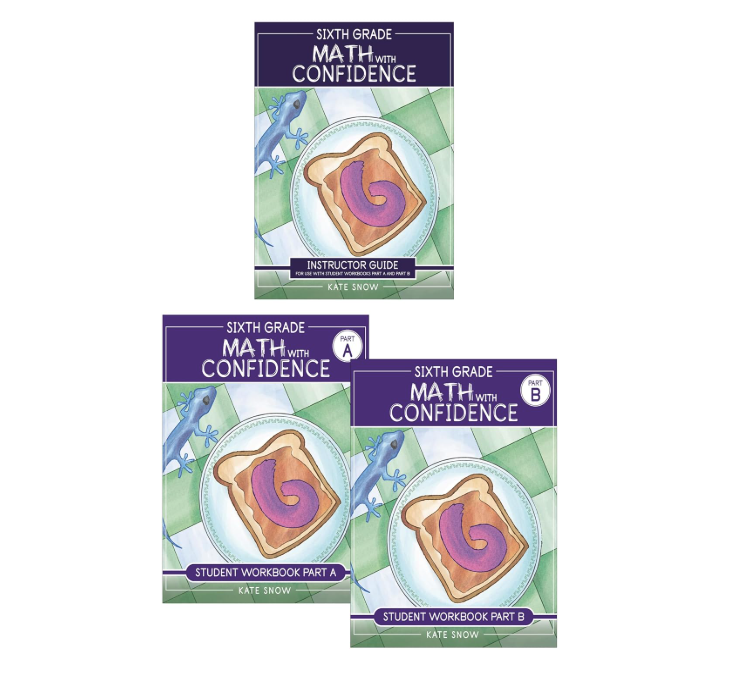
Sixth Grade Math with Confidence is a complete sixth-grade math program with three volumes: an Instructor Guide and two Student Workbooks.
- The Instructor Guide is the core of the program, with scripted lessons and hands-on activities and games that teach the key skills and concepts.
- The two Student Workbooks (Part A and Part B ) provide lesson activities, practice, and review. Workbook Part A covers Units 1-8, and Workbook Part B covers Units 9-16.
Sixth Grade Math with Confidence has 16 units in all. Units vary in length from 6 to 13 lessons, and there are a total of 139 lessons. 123 are regular lessons, and 16 are optional enrichment lessons.
You’re welcome to adjust the number of lessons you teach per week to best fit your family’s schedule. Some families prefer to teach math 5 days per week, while others prefer to teach math 4 days per week and leave one day open for co-ops, errands, or field trips. If you teach 4 lessons per week and teach all the enrichment lessons, the program will take you 35 weeks. If you teach 4 lessons per week and skip the enrichment lessons, the program will take you 31 weeks.
If you used Fifth Grade Math with Confidence, you’ll find the format for sixth grade very familiar. It has the same overall flow to the lessons, with three workbook pages per lesson and a unit wrap-up at the end of each unit.
What does a typical lesson look like?
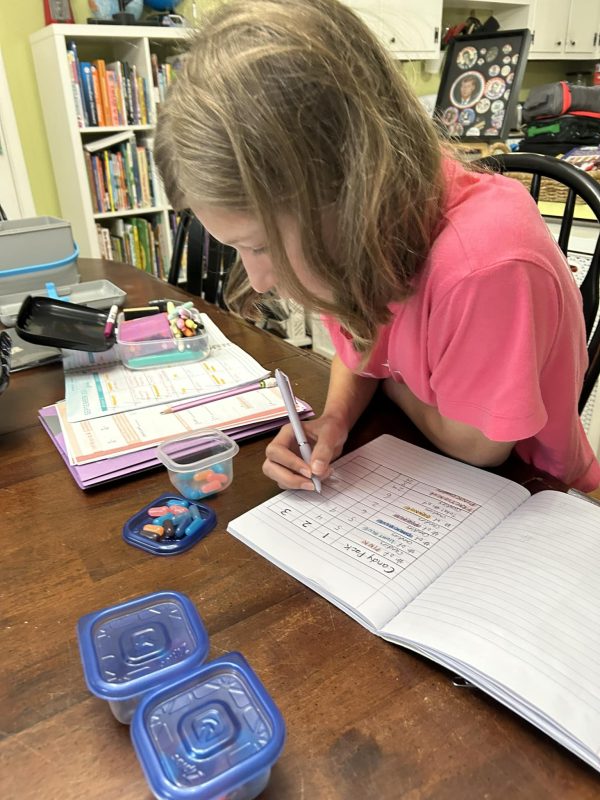
Most pilot families spent an average of 30-45 minutes on each lesson, with 10-15 minutes of parent-led instruction and 20-30 minutes of independent work. However, this will vary depending on your teaching style and your child’s learning style—and how many other kids you have interrupting you!
Each lesson includes 3 parts:
- Memory Work and Warm-up. Each lesson begins with a few memory work review questions and a quick warm-up activity. The warm-up activity eases your child into math time and helps start the lesson on a confident and positive note.
- Lesson Activities with Parent. Next, you’ll use the scripted lesson plan and Lesson Activities page in the workbook to teach your child new concepts and skills.
- Independent Practice. Last, your child will complete the Practice and Review workbook pages. On the Practice page, she’ll practice the new concept or skill you taught her. On the Review page, she’ll review previously-learned skills so that she retains them well.
Can I download a sample?
In these samples, you’ll find the full introduction, scope and sequence, and materials list, plus a variety of lessons from across the year so that you get a good sense of the program as a whole. Make sure to download all three files so that you can see how the Instructor Guide complements the Student Workbook.
What will my child learn?
Sixth Grade Math with Confidence is a full-year, comprehensive curriculum that covers everything your child needs to learn in sixth grade. He’ll learn how to:
- Review addition, subtraction, multiplication, and division with whole numbers
- Understand exponents and square numbers
- Add, subtract, multiply and divide fractions, mixed numbers, and decimals
- Use ratios and proportional thinking to solve problems involving speed, rate, and unit prices
- Calculate percentages and use percentages to solve real-life problems
- Use variables to write and solve simple equations
- Understand and compare positive and negative integers
- Graph points on the coordinate plane and use the coordinate plane to solve problems
- Find the volume and surface area of solid figures
- Find the area of triangles and parallelograms
- Calculate the range, mean, median, and mode for data sets
- Create line plots, histograms, and box plots and reason about data distributions
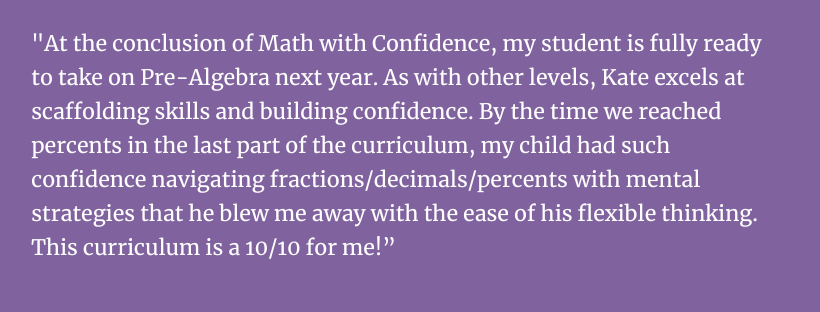
How does Sixth Grade Math with Confidence help children develop math study skills and greater independence in math?
Sixth graders are often eager for more independence in math–and their parents are often eager to reduce their teaching responsibilities! However, very few 11- or 12-year-olds are ready to study and learn math on their own. Even the most mature child will still need accountability, support, and the opportunity to ask questions.
Just like in the fifth-grade level, the lessons in Sixth Grade Math with Confidence are designed to both make the most of your teaching time and help your child develop the ability to read and study math more independently.
- The Lesson Activities pages have more examples and text to read together than in earlier grades. You and your child will read and study the examples together so that your child gradually develops the skill of learning math from a textbook. The printed text and examples also streamline the instructional time needed to teach the lessons.
- Some of the lessons include one-player games (rather than two-player games) that your child can complete on her own.
- Each unit includes a Unit Reference page that summarizes the core skills your child learned in the unit. These pages provide a summary of the key teaching in each unit so that your child can refer to them rather than immediately asking you for help. (You’ll find these pages at the back of each workbook.)
Don’t expect that your child will be able to work completely independently. The next couple of years are a gradual process of transferring responsibility to your child for her math learning, not an immediate or dramatic shift. Some days, your child may be able to zoom through her Practice and Review pages on her own, while other days she may still need you right by her side.
As in the previous levels, the Instructor Guide is an essential part of the program. Even if you don’t follow the scripted lesson word-by-word, make sure you use the Instructor Guide alongside the Student Workbook. The text on the Lesson Activities page summarizes the core concept or skill in each lesson, but there are often warm-ups, games, and explanations in the Instructor Guide that aren’t printed in the workbook.
I’ve kept the materials list as simple and budget-friendly as possible, just like in the earlier levels of Math with Confidence: counters, 2 packs of playing cards, 2 dice, a ruler, blank paper, pencils, and a highlighter. A few lessons also have optional suggestions for using base-ten blocks. If you already own base-ten blocks, you may want to keep them handy.
Is my child ready to start Sixth Grade Math with Confidence?
Your child is ready to start Sixth Grade Math with Confidence if he can:
- Solve whole-number multiplication and division problems (up to three digits times two digits or four digits divided by two digits).
- Find a fraction of a set or measurement.
- Add and subtract fractions or mixed numbers with different denominators.
- Multiply fractions and mixed numbers.
- Read, write, compare, and order decimals to the thousandths-place.
- Add and subtract decimals to the thousandths-place.
- Multiply and divide decimals by whole numbers.
- Find the volume of a rectangular prism.
- Find the mean and median for a small data set.
(Note that this is the bare minimum list of skills your child should know before starting Sixth Grade Math with Confidence. It is not a full list of everything covered in Fifth Grade Math with Confidence.)
If you have more questions about placement, check out this article for more advice and answers to frequently asked questions:
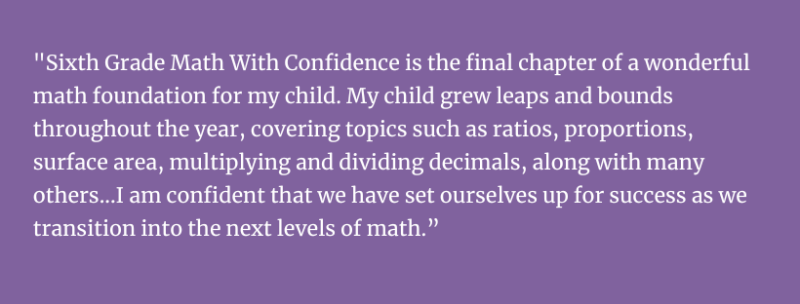
How are enrichment activities and picture books incorporated?
At the end of unit, you’ll find an enrichment lesson with a real-life math application activity. These are completely optional, and you can include as many or as few as you want over the course of the year.
Each enrichment lesson also lists suggested pages to read from What’s the Point of Math? from DK Publishing. This book makes a fun companion to Sixth Grade Math with Confidence. It includes many real-life examples of the topics your child will study this year, including prime numbers, data and statistics, and geometry.

What should I use after Sixth Grade Math with Confidence?
I’ve written an article full of recommendations for programs to use for seventh grade and beyond. I’ve also included sample trajectories for kids with a range of interests and goals, along with questions to consider as you choose an upper-level math program.
Where can I buy Sixth Grade Math with Confidence?
Digital copies (PDFs) and print copies are available now from Well-Trained Mind Press, Amazon, and other homeschool booksellers. Happy Math!
Congrats on completing the series! We love MWC! I’m curious about your thoughts for 7th grade & above. Will you be offering the middle grade math curriculums? If not, what do you recommend for MWC graduates? Thank you!
Thanks, Jessica! I’ll have suggestions for seventh grade and beyond soon, so stay tuned. 🙂
Happy Math!
Kate
Thank you!!
This math program is amazing and transformative. It makes learning math feel natural rather than tedious for children (and their adults). Thank you and congratulations on completing the series.
Thank you, Alexandra! I’m so glad you and your family have enjoyed it!
We’ve loved this so much we’ve worked ahead by two grades! My twin girls will start 6th grade MWC as 4th graders, and they enjoy it. This is my dream curriculum. I recommend it to everyone. Thank you so much to Kate Snow for putting in the work and gumption. My only grief is that now we are ruined for other math curricula going forward. For anyone considering this program, I highly recommend it for students who struggle and also for the quick learners. It’s effective, engaging, and beautiful.